

Following our introduction to EVA and the role that vinyl acetate (VA) content plays in determining material performance, the next question is often:
“Which EVA grade is right for my application?”
The answer depends on far more than simply selecting a material with the right flexibility or hardness. Every application makes different demands on the polymer, and choosing the right grade means understanding how the material will perform during processing, throughout its service life and in the final product.
A remarkably versatile material
One of EVA’s greatest strengths is its versatility. By varying the vinyl acetate content and other formulation characteristics, manufacturers can produce materials suited to a wide range of industries and applications. We explored this in our blog on What is EVA and why does vinyl acetate (VA) content matter?
Common uses include:
Automotive
- Interior trim components
- Cable insulation
- Protective mouldings
- Vibration and noise reduction components
Medical & healthcare
- Medical tubing
- Device components
- Pharmaceutical packaging
- Protective equipment
Footwear & sports
- Shoe midsoles and insoles
- Protective padding
- Sports equipment
- Shock-absorbing components
Packaging
- Flexible films
- Protective packaging
- Food packaging
- Heat-sealable products
Wire & cable
- Cable insulation
- Flexible jacketing
- Electrical protection
Industrial & consumer products
- Injection-moulded components
- Extruded profiles
- Adhesives
- Flexible seals and gaskets
- Household products
The wide variety of applications demonstrates why there is no single EVA grade to suit every manufacturing requirement.
Choosing an EVA grade? We’re here to help
Using the flowchart below, you can narrow down your specifications which will then help us to determine the correct grade for your needs.
Selecting the right material starts with understanding what your product needs to do.
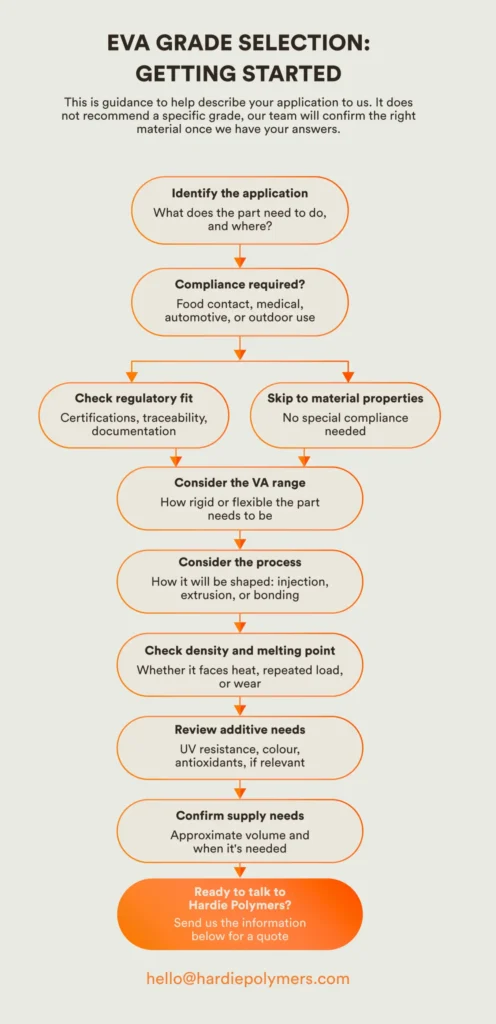
1. Does your application need to meet any compliance requirements?
Some industries require certified or traceable materials before a grade can even be considered. Questions to ask include:
- Is it for food contact?
- Is it for medical use?
- Is it for automotive applications?
2. How flexible does the product need to be?
Some applications require rigidity and dimensional stability, while others demand excellent flexibility and resilience. The required level of flexibility will influence the most suitable vinyl acetate content and overall material characteristics.
3. Which manufacturing process will be used?
Different EVA grades are optimised for different processing methods. These may include:
- Injection moulding
- Extrusion
- Film production
- Compounding
- Hot melt adhesive applications
Selecting a grade suited to your manufacturing process can improve productivity while reducing waste and processing issues.
4. What environment will it operate in?
Consider the conditions the finished product will experience throughout its life. Questions to ask include:
- Will it experience low temperatures?
- Does it require good chemical resistance?
- Will it be used indoors or outdoors?
Understanding the operating environment helps narrow down the grade options.
5. What physical demands will it face?
Beyond the environment, consider the mechanical and thermal loads the product will need to withstand. Questions to ask include:
- Will it experience repeated impacts or loads?
- Does it need to resist softening under heat?
- Does it need long-term durability without flattening or wearing down?
These factors affect density, melting point and compression performance, and help confirm the material will hold up throughout its working life.
6. Are there any additive requirements?
Beyond the base polymer, additives can be built into the grade to meet specific performance needs. You may need to consider:
- UV or weathering resistance
- Antioxidant protection
- Slip agents for processing or handling
- Flame retardancy, if relevant to your application
Getting the additive package right at this stage avoids performance issues further down the line.
7. Are appearance and finish important?
For many products, performance is only part of the specification. You may also need to consider:
- Surface finish
- Transparency
- Colourability
- Soft-touch feel
- Gloss
The right EVA grade can help achieve both the required aesthetics and technical performance.
8. What are your commercial requirements?
Material selection should balance technical performance with commercial objectives. Factors such as availability, processing efficiency, consistency of supply and overall value are often just as important as physical properties. Working with an experienced polymer supplier can help identify grades that meet both technical and commercial requirements.
Why technical guidance matters
With so many grades available from different manufacturers, selecting the right EVA grade can quickly become complex. That’s where independent technical support adds real value. Rather than recommending a single manufacturer’s product, we work with a broad network of trusted suppliers to identify the most appropriate material for your application. Whether you’re replacing an existing grade, improving product performance or developing an entirely new product, we take the time to understand your requirements before recommending a solution.
Independent technical help
Choosing the right polymer shouldn’t be a case of trial and error.
Our EVA specialist, Matthew Crabbe, works closely with our customers to understand their application, manufacturing process and performance requirements before helping identify the most suitable grade.
From sourcing specialist materials to providing technical guidance throughout the selection process, our aim is to make material choice simpler, faster and more effective.